

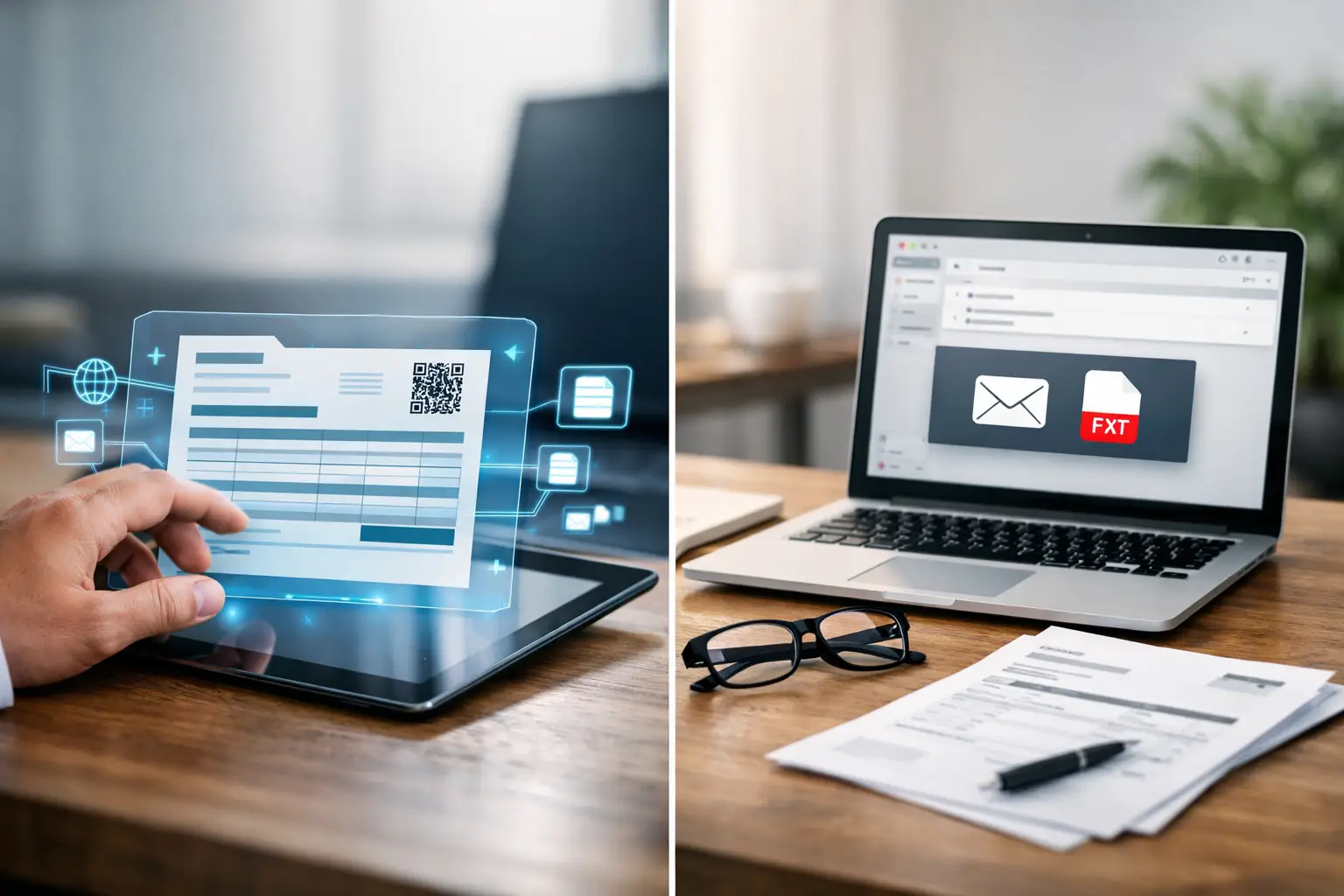
Peppol Invoicing vs Email Invoices
An invoice sent to the wrong email address, a PDF keyed in by hand, a payment delayed because one field was missing – these are small failures that create bigger finance problems over time. When businesses compare Peppol invoicing vs email invoices, the real question is not just how an invoice is delivered. It is whether your invoicing process supports accuracy, compliance, and real-time visibility as transaction volume grows.
For many SMEs, email invoices are familiar and easy to start with. They require no major process change at the beginning, and almost every customer or supplier can receive them. But familiarity is not the same as control. As finance teams push for faster month-end closing, cleaner audit trails, and fewer manual touchpoints, email starts to show its limits.
Peppol invoicing changes the process by turning invoice exchange into structured digital data rather than a document someone has to read, forward, or re-enter. In markets such as Singapore, where InvoiceNow supports nationwide e-invoicing adoption, that shift matters because it improves not only efficiency, but also compliance readiness and transaction traceability.
Peppol invoicing vs email invoices: the core difference
Email invoicing is document-based. A business creates an invoice, usually as a PDF, and sends it to a recipient’s inbox. The recipient then opens the attachment, checks it, and often rekeys the details into an accounting or ERP system. Even when the process is organized, it still depends heavily on people reading, routing, validating, and entering data correctly.
Peppol invoicing is data-based. Instead of sending a document for manual handling, the sender transmits a structured invoice file through the Peppol network directly into the recipient’s compatible finance system. That means invoice fields such as supplier name, invoice number, tax amount, line items, and payment terms are standardized and machine-readable from the start.
This is why the comparison is not simply PDF versus electronic file. It is manual workflow versus structured workflow.
Why email invoices still dominate in many SMEs
Email remains common because it is flexible, cheap to start, and widely understood. A small business can generate a PDF from almost any system and send it immediately. There is no onboarding to a network, no mapping of data fields, and no need to confirm whether the recipient has e-invoicing capability.
That simplicity has value, especially for low invoice volumes or businesses with a scattered customer base. If your team sends only a small number of invoices each month, the friction of changing process may feel larger than the gains.
But the hidden cost appears as volume increases. Finance staff spend time following up on receipt, checking version mismatches, re-entering invoice details, matching attachments to purchase orders, and resolving disputes caused by inconsistent formats. Email works, but it scales badly when the business needs tighter control.
Where Peppol invoicing creates operational gains
The biggest advantage of Peppol is data integrity. Because invoice data is sent in a standardized format, the receiving system can process it with much less manual intervention. That reduces keying errors, shortens approval cycles, and improves downstream reconciliation.
For accounts receivable, this can mean faster invoice submission and fewer delays caused by formatting issues or missing fields. For accounts payable, it means less time spent opening emails, downloading attachments, and manually capturing invoice data.
There is also a visibility benefit. Structured invoicing gives finance and operations teams a cleaner record of what was sent, when it was delivered, and how it entered the transaction flow. In an ERP environment, that supports better tracking across sales, purchasing, tax, and reporting.
For growing SMEs, this matters because invoicing is rarely isolated. It affects customer collections, supplier payments, GST treatment, audit preparation, and cash flow forecasting.
Accuracy, compliance, and auditability
If your invoicing process is still email-based, compliance depends a lot on discipline. Teams must attach the right file, include the correct references, apply the right tax treatment, and make sure the recipient receives a readable and complete invoice. Even with good internal controls, human error remains part of the process.
Peppol reduces some of that risk by enforcing a more structured exchange. Required fields are more consistently handled, and data flows in a standardized way. That does not remove the need for internal review, but it does lower the chance of mistakes caused by document handling.
For businesses operating in Singapore, this becomes especially relevant. InvoiceNow and Peppol adoption align with broader digital compliance and finance modernization efforts. If your business is already planning for stronger controls around GST reporting, invoice validation, and traceable transaction records, structured e-invoicing supports those goals better than email alone.
Auditability improves too. Email chains can be messy. Attachments get renamed, forwarded, or buried in inboxes. Structured invoice transmission provides a clearer digital trail, which is useful when finance teams need to verify dates, values, and document status quickly.
Peppol invoicing vs email invoices in day-to-day finance work
In practice, the difference shows up in routine tasks.
With email invoices, accounts payable teams often monitor shared inboxes, check supplier details manually, match invoice values against purchase orders, and enter data line by line. Accounts receivable teams may need to resend invoices because the original email was missed, rejected, or sent to the wrong contact.
With Peppol invoicing, more of that work can be standardized. Invoice data arrives in a format the system can recognize. Matching and validation become more consistent. Teams spend less time handling documents and more time managing exceptions.
That shift is valuable because finance capacity is limited. Most SMEs do not want skilled staff spending hours on repetitive capture and correction work. They want those teams focused on cash flow control, supplier management, variance review, and faster month-end closing.
The trade-offs: when email may still make sense
Peppol is not automatically the best option for every invoice in every business. It depends on your transaction profile, customer and supplier readiness, and system maturity.
If many of your trading partners are not yet connected to the Peppol network, email may still remain part of the process for some time. If your invoice volume is low and your approval requirements are simple, the efficiency gains may be more modest in the short term.
There is also an implementation factor. Structured invoicing works best when it is connected to the underlying finance system properly. If invoice data is poor at source, automating the exchange will not solve process weaknesses upstream. It may simply expose them faster.
So the choice is not always either-or. For many SMEs, the practical path is a hybrid transition: use Peppol where trading partners and systems support it, and manage email invoices as an exception rather than the default.
What SMEs should look at before making the switch
A useful evaluation starts with process friction, not just technology. If your team is spending too much time on invoice re-entry, correction, approval delays, or payment disputes, those are strong signals that email-based invoicing is limiting efficiency.
You should also look at whether invoicing is integrated with your broader operations. When sales, purchasing, inventory, and accounting sit in separate systems, invoice issues multiply. A structured ERP environment makes Peppol adoption more effective because invoice data is tied to the source transaction, not assembled manually at the end.
This is where an implementation-ready platform matters. If your ERP supports InvoiceNow and Peppol while also connecting invoicing to stock movement, purchasing controls, and financial reporting, the benefit is larger than sending invoices in a different format. You get better process consistency across the business.
For SMEs planning structured growth, that is the bigger opportunity. The objective is not just to send invoices faster. It is to reduce manual work, improve traceability, and create reliable financial data that supports better decisions.
A practical decision framework
If your business values convenience above all else and invoice volume is still manageable, email invoices may continue to work for now. But if you are already feeling the strain of manual processing, unclear audit trails, and slow reconciliation, Peppol is usually the stronger long-term model.
The gap becomes even clearer when customers, suppliers, or public-sector requirements push for standardized e-invoicing. At that point, staying with email often means carrying more administrative burden than necessary.
A2000ERP approaches this as a finance operations issue, not just a file transmission issue. When Peppol and InvoiceNow capabilities are built into a broader ERP workflow, SMEs can gain real-time visibility, reduce rework, and improve control without adding enterprise-level complexity.
The best next step is to look closely at where your invoicing process breaks under pressure. That is usually where the right answer becomes obvious.
