

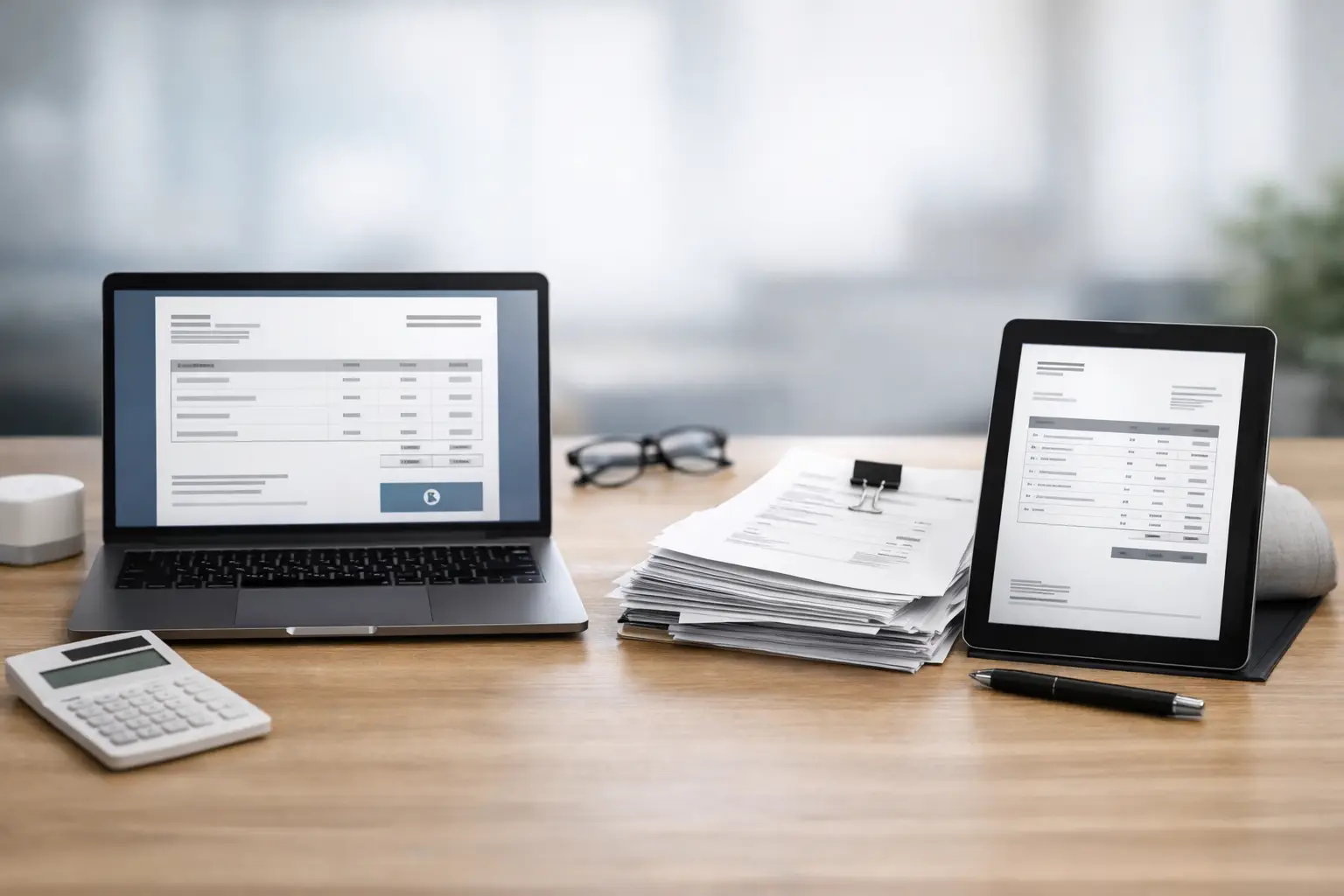
InvoiceNow Versus PDF Invoices
A finance team sends an invoice on Friday, then spends the next week answering whether it was received, rekeying line items into another system, and fixing a tax or pricing error that started with a PDF attachment. That is the real difference in InvoiceNow versus PDF invoices. One is built for machine-readable business processing. The other is still largely a document someone has to open, read, and manually act on.
For small and midsize businesses, this is not just a formatting choice. It affects processing speed, dispute rates, audit trails, cash flow visibility, and how much manual work your team carries every month. If your business is trying to improve finance operations without adding headcount, the gap becomes hard to ignore.
InvoiceNow versus PDF invoices: what changes in practice
A PDF invoice is essentially a digital paper document. It may look clean and professional, but it usually depends on email delivery and manual handling. Someone receives it, downloads it, checks it, keys details into accounting or ERP software, and then routes it for approval or payment.
InvoiceNow works differently. In Singapore, InvoiceNow is the national e-invoicing framework based on the Peppol network. Instead of sending an invoice as a visual document attachment, the invoice data is transmitted in a structured digital format directly from one system to another. That means customer details, invoice number, dates, amounts, tax information, and line items can move into the receiving system with far less manual intervention.
That single change matters because finance delays rarely come from creating the invoice itself. They come from re-entry, validation, matching, and follow-up. Structured e-invoicing removes friction from those downstream steps.
Why PDFs still create operational drag
PDF invoices remain common because they are familiar. They are easy to generate, easy to email, and easy to store. For a very small business with low invoice volume, they may feel sufficient.
But sufficiency is not the same as efficiency. A PDF still creates dependency on people. If a customer keys the invoice incorrectly, the error enters their process. If your team receives supplier PDFs, they often need to extract data manually before matching against purchase orders or goods receipts. If the invoice format varies by supplier, the workload increases further.
The problem compounds as transaction volume grows. Manual checks that felt manageable at 30 invoices a month become a control risk at 300. Finance teams start spending time on avoidable exceptions instead of higher-value work like cash planning, credit control, or month-end review.
PDFs also create weak spots in traceability. Yes, the document exists, but that does not mean the data flowed consistently into your finance and operational records. If inventory, procurement, and accounting are disconnected, a PDF often becomes another isolated file rather than a clean transaction in a structured system.
Where InvoiceNow delivers stronger control
InvoiceNow is not simply faster email. It is a standardized method for transmitting invoice data between connected systems. That gives businesses several operational advantages.
First, it reduces manual data entry. That alone lowers the chance of input errors in pricing, quantities, tax codes, and invoice references. Fewer errors usually mean fewer payment disputes and fewer delays in accounts receivable and accounts payable processing.
Second, it improves processing speed. When invoice data arrives in a format your system can read, validation and routing can begin immediately. This supports faster approvals, faster reconciliation, and in many cases faster month-end closing.
Third, it strengthens compliance and auditability. Structured invoice data creates a clearer digital record of what was sent, received, and processed. For businesses operating in regulated environments or preparing for growth, that matters. Finance leaders need more than document storage. They need transaction visibility.
Fourth, InvoiceNow supports better scalability. As invoice volume increases, the process does not have to become proportionally more labor-intensive. That is one of the main reasons growing SMEs move away from document-led invoicing.
InvoiceNow versus PDF invoices for SMEs
For SMEs, the decision is usually not philosophical. It comes down to cost of processing, speed of collection, and operational discipline.
If your invoicing process is still centered on PDFs, your team may be absorbing hidden costs that do not appear as software line items. These include rekeying time, missed invoice status updates, duplicate checks, approval bottlenecks, and payment delays caused by formatting or reference errors. None of those issues are unusual. They are common signs that the invoice process is still document-based instead of data-based.
InvoiceNow is better suited to businesses that want finance processes to scale with the rest of the company. That includes businesses dealing with frequent invoices, procurement-heavy workflows, multi-department approvals, or a need for stronger reconciliation between sales, purchasing, and accounting.
This is especially relevant in Singapore, where InvoiceNow adoption aligns with broader digitalization and compliance expectations. For businesses that want to modernize in a way that supports both operational efficiency and regulatory readiness, the case is practical rather than theoretical.
The trade-offs are real
That said, PDFs are not disappearing overnight, and InvoiceNow is not automatically the right fit in every situation.
If your customers or suppliers are not ready for structured e-invoicing, you may still need to support PDFs for part of your invoice flow. Some businesses operate in mixed environments where one group can receive InvoiceNow transactions and another still relies on email attachments. In that case, the goal is not immediate full replacement. It is controlled transition.
There is also a setup requirement. InvoiceNow works best when it is integrated into a broader finance and ERP process, not treated as a standalone patch. Businesses may need to align customer records, tax settings, approval workflows, and invoice formats so that the data transmitted is complete and accurate. That implementation effort is worthwhile, but it should be planned properly.
The key point is this: PDFs are simpler to start with, while InvoiceNow is stronger to operate with at scale. One reduces the change burden today. The other reduces processing burden over time.
What to evaluate before moving away from PDFs
If you are deciding between InvoiceNow and continued PDF invoicing, start with your actual finance workload.
Look at how many invoices your team sends and receives each month. Review how often invoice data is manually keyed into another system. Measure how many payment delays come from missing information, mismatched references, or approval lag. Check how easily your team can trace an invoice from issue to payment and tie it back to sales, purchasing, and GST records.
If those answers reveal recurring manual effort, then the invoice format is no longer just an admin detail. It is part of your operational design.
This is where an ERP-led approach matters. InvoiceNow delivers the most value when invoice data connects directly to accounting, receivables, payables, purchasing, and inventory processes. A2000ERP supports that structured approach by combining InvoiceNow readiness with broader workflow control, so invoicing does not sit apart from the rest of the business. That matters if your goal is not just sending invoices faster, but reducing manual work across the full transaction cycle.
The bigger issue is data quality
The real debate in InvoiceNow versus PDF invoices is not document preference. It is whether your finance operation runs on files or on structured business data.
PDFs can still serve a purpose as a human-readable record. Many businesses will continue to use them for reference, communication, or counterparties that are not yet fully digitalized. But as a primary invoicing method for a growing company, PDFs often preserve bottlenecks that finance teams are already trying to remove.
InvoiceNow gives businesses a way to standardize invoice exchange, improve accuracy, and create better real-time visibility across finance operations. That is not only useful for accounts teams. It helps leadership make better decisions with cleaner and more timely data.
If your invoicing process still depends on someone opening an attachment and typing the same information twice, the issue is bigger than formatting. It is a sign your business may be ready for a more structured way to work.
